
The Role of AI in Apparel Design and Fashion Trend Forecasting
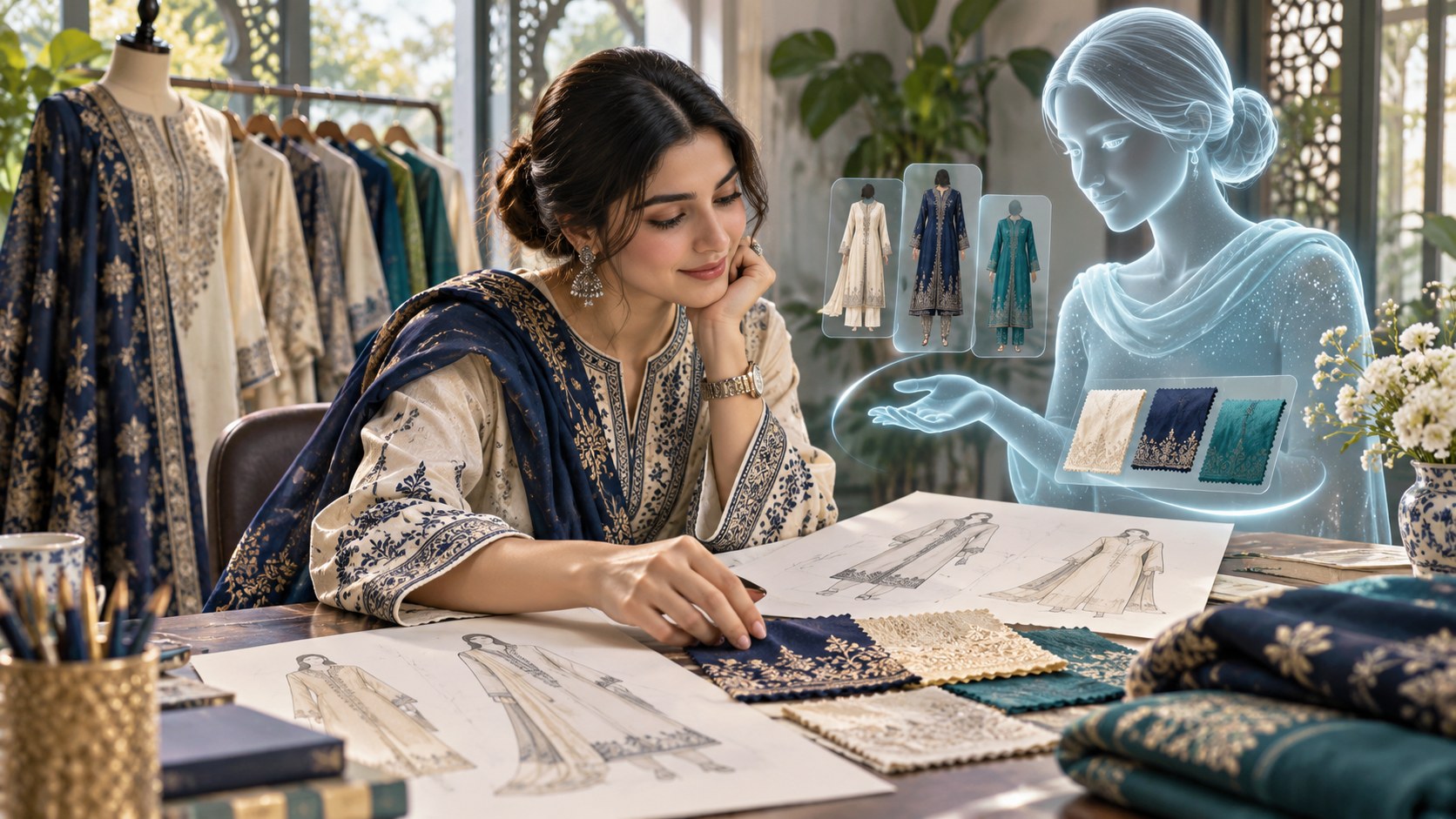
A guide from QC – Qurat Clothing (SMC-Private) Limited
AI can produce a striking clothing concept quickly, but a convincing image does not answer every question a designer or buyer must resolve. Can the garment be constructed? Does the material behave as shown? Is the apparent trend relevant to the intended customer? These questions connect creative exploration with practical apparel decisions.
Qurat Clothing shares this guide for readers interested in fashion and AI-assisted retail. It does not claim that the company manufactures AI-designed garments or uses a particular trend-prediction system. When shopping, rely on the selected item’s actual photographs, measurements and details.
Separate design exploration from forecasting
Design exploration asks what a garment could look like. Trend forecasting asks what styles or attributes may attract interest in a future context. The first can generate possibilities; the second needs evidence and a clear definition of the audience, location and time period.
A popular-looking generated design is not proof of future demand. Similarly, a pattern in online searches does not specify how a garment should be constructed. Keep the creative brief and the research question separate so each can be evaluated properly.
Use generative tools to explore directions
Image tools can help compare silhouette, colour combinations and presentation ideas. Supply a focused brief describing the intended use, audience and constraints. Ask for a manageable set of distinct concepts rather than producing a large collection without selection criteria.
Adobe’s style-reference guidance illustrates how a reference can influence generated visual style. That capability supports exploration; it does not guarantee exact garment construction or faithful reproduction of a supplied product.
Build a practical design brief
State the garment type, intended wearer, usage context, required coverage, target fit and known production constraints. Identify which details are fixed and which are open for exploration. If a design must use a particular available fabric, include its verified specification rather than a visual guess.
Ask the tool to keep alternatives comparable. For example, changing background, pose and silhouette simultaneously can make it difficult to decide which garment direction is strongest. A controlled comparison helps the team explain why a concept was selected.
Review what the image hides
Inspect seams, closures, pockets, sleeve connections and how the garment would be put on. Generated images can contain inconsistent details or imply a construction that does not work. An experienced designer or maker should translate a selected visual into an appropriate technical specification.
Material behaviour also needs checking. A rendered fabric may drape, stretch or reflect light unrealistically. Do not infer fibre composition or performance from an image. Use samples and reliable specifications when the decision depends on those properties.
Move from concept to validation
A selected image should lead to questions for sampling and fit review, not directly to a large production commitment. Record the design decisions, unresolved issues and changes made by the technical team. Keep the concept distinct from the approved version.
Where the business is selling existing garments, the task is different: presentation should preserve the actual product. A generated styling image must not change a print, neckline, sleeve length or available colour. The customer needs to understand the item being offered.
Research trends with a defined question
Choose the attribute and context you want to investigate. “Are loose-fit silhouettes appearing more often in the sources we follow?” is more testable than “What will everyone wear next year?” Record the sources, observation period and limitations.
Distinguish runway concepts, social attention, search interest, product assortment and completed sales. These signals describe different activities. A useful research brief explains which one supports each observation rather than combining them into an unsupported demand claim.
Use AI to organise evidence
An assistant can group supplied observations by silhouette, colour or garment type and prepare a source register. Require a reference for each important statement. Ask it to preserve conflicting evidence and mark gaps instead of forcing a single confident trend narrative.
Our AI business-research guide explains how to separate observations from recommendations. The same discipline helps fashion research remain useful when the evidence is incomplete.
Understand the limits of external signals
Online engagement may come from people outside the intended customer group. A striking outfit may attract views without fitting the business’s price range, available stock or customers’ practical needs. Search interest can also reflect curiosity rather than purchase intent.
The research article Well googled is half done investigates combining external trend information with new-fashion-item forecasting. Its stated experiment is evidence for that research setting, not a promise that any social or search signal will predict a retailer’s sales.
Connect the idea to the available assortment
For export-surplus apparel, buying opportunities may involve fixed quantities and uneven sizes. A trend direction cannot create unavailable stock or make two similar garments identical. Compare the actual lot, condition and size assortment before using a trend brief to support purchasing.
A retailer may instead use research to improve how existing items are explained and grouped. Styling advice can highlight verified features without inventing a new brand, composition or origin. Keep the recommendation relevant to the item’s real fit and design.
Protect product fidelity in marketing
Compare generated content against original photographs before publication. Check colour, print wording, embroidery, garment length and visible details. If a visual is a concept or styling illustration, make its role clear wherever shoppers could mistake it for the exact product.
Qurat Clothing readers can use our measurement and photograph checklist to understand the evidence needed for product comparison. Attractive imagery works best when it strengthens clarity rather than replacing it.
Keep a review record
Save the brief, selected concept, source references and reasons for revision. Record which version was approved and who checked the practical details. This reduces confusion when different team members work on design, sourcing and marketing.
Review the tool’s current terms and the organisation’s rules for reference material before using supplied images commercially. Do not assume that generating a variation removes all responsibilities connected with the inputs or the final content.
A useful first experiment
- Select one bounded design or research question.
- Prepare verified inputs and clear constraints.
- Generate or organise a small set of alternatives.
- Review technical feasibility or source quality.
- Choose a reversible next step, such as a sample or a closer product comparison.
- Evaluate the outcome before expanding.
Judge the experiment by whether it helps a real decision. Producing more images or a longer trend report is not automatically useful progress.
Frequently asked questions
Can AI replace a fashion designer?
It can support exploration, but practical design also requires material knowledge, construction, fit and judgment about the intended wearer.
Does a trend forecast guarantee sales?
No. Demand depends on the customer, product, price, availability and many other conditions. Keep uncertainty visible.
Can a generated model image change the product design?
For a real product listing, preserve the actual garment’s identifying details. A changed concept should not be presented as the exact item for sale.
Key takeaway
AI can broaden creative exploration and organise trend evidence. Use it within a process that checks feasibility, source quality and product fidelity, then connect the result to a realistic decision rather than treating visual appeal as proof of demand.
Explore Qurat Clothing
Visit Qurat Clothing to browse current apparel. Compare the selected item’s photographs, measurements, condition notes and available sizes before ordering.
Comments
Be the first to comment.