
How AI Agents Are Transforming the E-commerce Industry
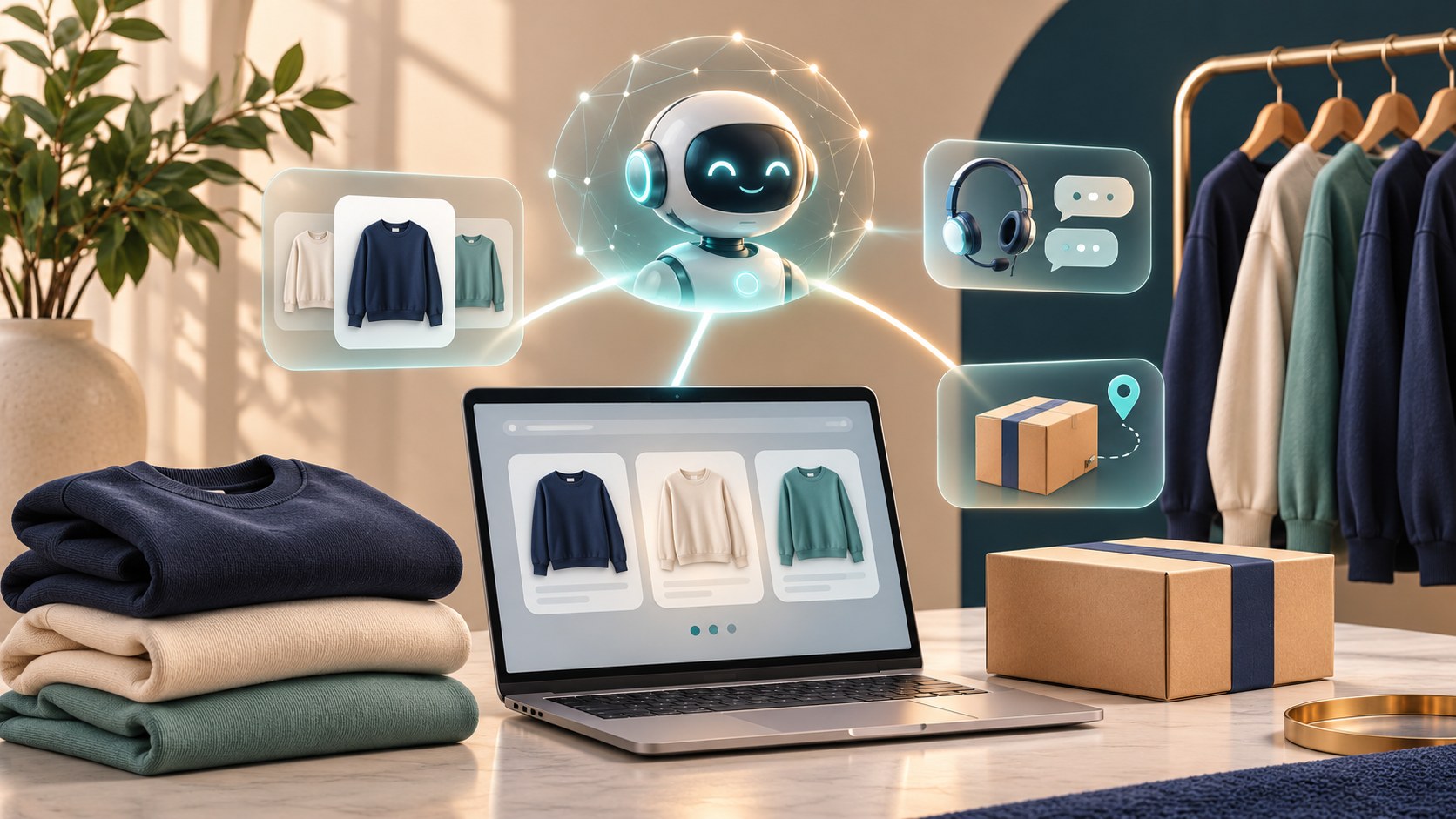
A guide from QC – Qurat Clothing (SMC-Private) Limited
For an online apparel retailer such as Qurat Clothing, AI becomes useful when it helps customers understand the exact garment, available size and next shopping step. This guide connects the technology to those everyday retail questions.
AI agents are changing e-commerce by connecting a customer request or business goal with a sequence of useful actions. A properly integrated agent might search a catalogue, check a selected size, prepare a response and route an unresolved question to an employee. The opportunity is practical: reduce repeated handoffs while keeping product facts, customer choices and business rules intact.
That opportunity should not be confused with a fully self-running store. This article offers an implementation perspective for small retailers. Its apparel scenarios are hypothetical; they do not describe verified technology deployments or performance results at Qurat Clothing.
What does an AI agent do in an online store?
An AI agent uses a model to decide how to pursue a task and can use connected tools to gather information or take permitted actions. OpenAI’s practical guide to agents distinguishes these systems from applications that generate responses without controlling a workflow. The distinction matters when a vendor promises that a chatbot can “manage” a store.
Ask what the system can actually access. Reading a delivery policy, looking up an order and changing an order are separate capabilities. Each requires its own integration and permissions. A convincing demonstration of conversation does not establish that the agent can complete those actions reliably in your business.
Where could agents make retail work more useful?
Product information and catalogue enquiries
Consider a shopper asking for a navy sweatshirt with particular garment measurements. A proposed agent workflow could identify the relevant product records, compare available sizes and explain where information is missing. The catalogue should remain the factual source. If a fabric label is unreadable, the answer should say so instead of filling the gap with a likely composition.
For export-surplus clothing, retain each item’s identifying code, photographs and actual variant information. Similar appearance does not mean two garments have the same dimensions or construction. A useful assistant preserves those differences when preparing a shortlist.
Customer support with a clear handoff
An agent-assisted support process could collect an order reference and a concise account of the issue before an employee responds. The value is a better prepared case, rather than simply a faster greeting. Staff should receive the facts already collected, the sources checked and the question still requiring a decision.
Keep a visible route to a person. If a customer disputes a product description or asks for an exception to policy, the system should avoid presenting an automated interpretation as a final settlement.
Operational exception queues
Another candidate is an internal queue of incomplete records: a missing product measurement, an unmatched courier reference or an unclear order note. The agent could explain what needs attention and draft a task for the responsible employee. Start with this advisory role before allowing it to change customer-facing records.
Agent, workflow or ordinary software?
Anthropic’s engineering guidance separates predefined workflows from agents that select their own next steps. A retailer should choose between them according to the work, rather than the popularity of the label.
| Retail task | Suggested starting approach | Reason |
|---|---|---|
| Calculate a fixed delivery charge | Ordinary business logic | The rule should give a predictable result. |
| Send an approved dispatch update | Defined workflow | The trigger and message can be specified. |
| Interpret a mixed product enquiry | Assistant or bounded agent | The request may need clarification and several lookups. |
| Approve an unusual refund | Employee decision with AI preparation | The case needs accountable judgement. |
A simple solution is often easier to maintain. Before buying an agent platform, check whether a better search filter, cleaner size chart or standard response template would remove the same problem.
A hypothetical clothing-store example
Imagine a customer requesting two outfits for children of different ages. The customer supplies one set of measurements but does not identify which child it belongs to. A poorly designed system might recommend two age labels immediately. A better pilot would ask for clarification, keep each child’s requirements separate and compare the correct measurements against each product.
The agent could then prepare a shortlist containing product codes, available variants and unresolved questions. The customer would still confirm the selection. If the inventory lookup fails, the system would report that availability could not be verified rather than treating an older result as a reservation.
Assess the example by the quality of the completed shortlist. A long conversation that ends with the wrong size is not a successful outcome, even if every message sounds helpful.
What should a retailer prepare first?
- Reliable records: maintain product codes, variant quantities, measurements and current policies.
- A narrow task: choose one repeatable enquiry with a clear definition of success.
- Limited access: separate reading information from changing orders or stock.
- A responsible employee: give someone ownership of errors and escalations.
- A fallback: provide a usable manual process when the integration is unavailable.
Write down what “complete” means. For a size enquiry, it might mean presenting a supported comparison and identifying any missing measurement. For an order enquiry, it might mean returning a verified status after appropriate identity checks. These are different tasks and should have different evaluation cases.
Costs, limitations and practical controls
Budget for setup, integrations, staff review and maintenance alongside any subscription or usage charge. Ask suppliers to demonstrate how they handle failed lookups, conflicting records and duplicate requests. Obtain an export route for your business data and a clear explanation of who maintains the connection when your store software changes.
Inaccurate generated information is a recognised concern in the NIST Generative AI Profile. For a retail pilot, a practical response is to require evidence for product claims, log permitted actions and stop unsupported answers. Do not let confident wording substitute for a successful stock or order lookup.
Customer messages and supplier documents should be treated as information to interpret, not as instructions that can override the store’s rules. Test messages that ask the assistant to reveal another customer’s order or ignore its permissions. A failure on these cases should block wider access.
How to measure whether the pilot helps
Record a baseline before launch: employee handling time, corrected answers, unresolved cases and customer follow-up. During the pilot, compare similar enquiry types and include the time spent checking AI output. Keep simple enquiries separate from complicated disputes so the comparison remains useful.
A suggested review sheet should record the requested task, evidence used, outcome, staff correction and total handling time. Review failures by cause. Missing data calls for record improvement; a poor tool connection calls for integration work; misunderstood intent may call for clearer questions or a narrower scope.
Frequently asked questions
Does every online store need an AI agent?
No. Start with a specific operational problem. A small catalogue with straightforward enquiries may benefit more from accurate pages and ordinary automation.
Can an agent run the entire store?
Do not assume this from a product demonstration. Evaluate each task, integration and permission separately, and retain human responsibility for exceptions.
Will an AI agent guarantee more sales?
No. Assess supported answers, completed tasks and business outcomes in a controlled pilot. Avoid treating conversation volume as proof of additional sales.
Key takeaways
- Evaluate the completed retail task, not just the fluency of the conversation.
- Use product records as evidence and identify missing information.
- Introduce write permissions gradually and keep an accountable handoff.
- Measure review costs as part of the result.
Conclusion
AI agents offer retailers a way to connect information and routine work more closely. A useful starting point is one bounded task with trustworthy records, visible limits and measurable outcomes. That approach gives an apparel business evidence for its next investment while protecting the accuracy customers need to shop confidently.
Related clothing guides
- How to prepare garment-measurement photographs for a size enquiry
- How to request an alternative when export-surplus stock sells out
Sources and further reading
- OpenAI: A practical guide to building agents
- Anthropic: Building effective agents
- NIST: Generative Artificial Intelligence Profile
Research checked: 13 November 2026. Business examples and implementation recommendations are illustrative.
Explore Qurat Clothing
Visit Qurat Clothing to browse current apparel and review each item’s photographs, measurements and available sizes. For purchase decisions, check the selected product and the store’s current terms.
Comments
Be the first to comment.