
How to Measure Garment Changes Before and After Washing
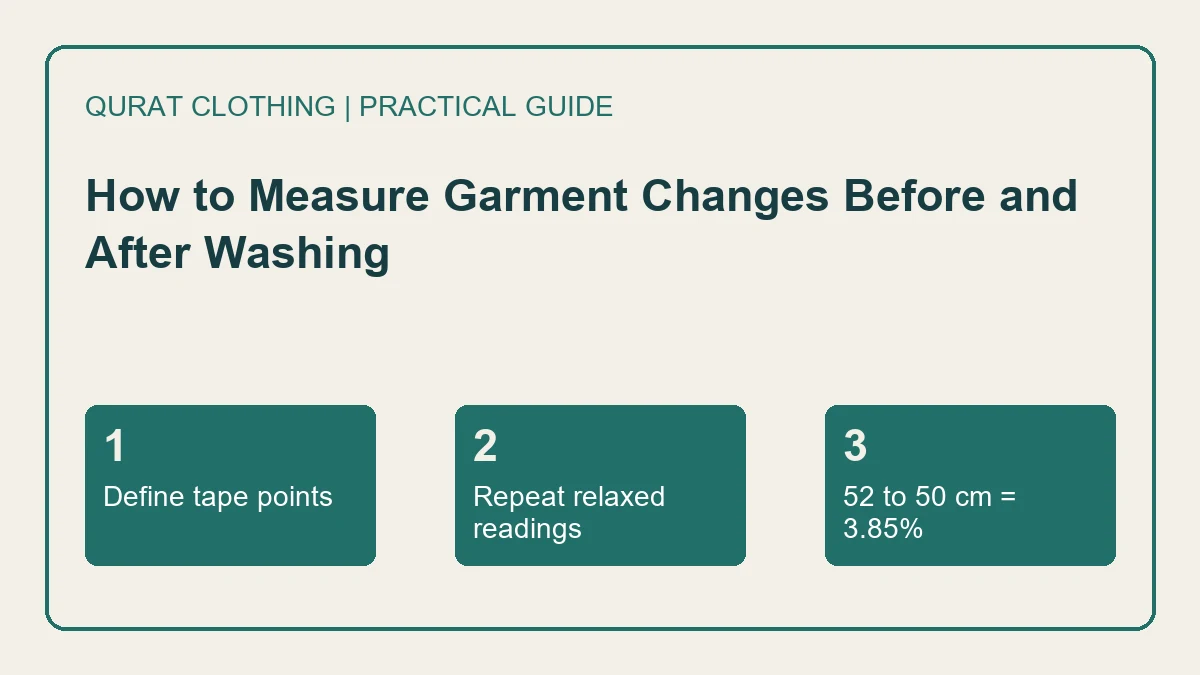
Measure a garment before and after washing at the same points, in a relaxed condition, using the same method. The comparison can show dimensional change in that item. It cannot, by itself, establish the cause, prove a manufacturing fault or predict what every garment of the same fibre will do.
Make a simple baseline
Before the first wash, read and photograph the care label. Lay the garment flat on a suitable surface without pulling it wider or longer. Note its condition and take an overall photograph. Record the measurement points used by the seller where possible so your notes remain useful for shopping as well as care.
For a top, useful points may include flat chest width and a clearly defined body length. For trousers, record relaxed waist method, inseam and another relevant dimension such as thigh width. Different styles need different points. Do not mix body measurements with garment measurements.
Write down the starting and finishing points
Shoulder-to-hem and back-neck-to-hem are different lengths. A curved seam and a straight tape line are different routes. If you simply write length 52 cm, a later comparison may be ambiguous. A small sketch or photograph showing the tape endpoints is more useful.
Use the same tape and repeat the reading without stretching the fabric. If repeated readings differ, record that uncertainty rather than choosing the number that best supports a conclusion. Do not expect a soft garment laid by hand to produce laboratory precision.
Record the actual care process
Note the wash method, selected programme or hand-wash approach, temperature where known and drying method. Record anything you did differently from the label. Do not recreate a damaging process merely to test a theory. A consumer record is an observation of ordinary use, not a textile certification.
Let the garment reach a fully dry, relaxed condition before the second measurement. Comparing a damp, stretched item with a dry baseline introduces another difference. Follow any label instructions about reshaping; record that action too.
Calculate each dimension separately
As a hypothetical example, suppose the same defined body length changes from 52 cm to 50 cm. The reduction is 2 cm. Relative to the original, 2 divided by 52 multiplied by 100 is about 3.85 percent. That percentage describes this length reading, not every dimension or the wearer's body.
If chest width changes from 40 cm to 39 cm, its recorded reduction is 2.5 percent. Do not average those two percentages into a claim that the entire garment shrank by a precise amount. Length and width can behave differently, and measurement uncertainty still matters.
Interpret the result cautiously
An observed difference can be useful even when its cause is uncertain. It may help you explain a concern or select a future reference garment. It does not justify claiming that all cotton shrinks by a fixed percentage, or buying the wrong size in anticipation of a predicted change.
Our shape-change guide helps describe local changes such as cuffs or knees. For a new purchase, keep the original photographs and contact Qurat Clothing before attempting a heat treatment or alteration. Read the return policy rather than assuming every post-wash concern is eligible.
For future shopping, compare current listings in boys', girls', men's or women's clothing with a garment whose present fit you like. Measurements are more helpful when their method is clear than when their decimal places look precise.
Two readings after a wash
A hypothetical reference top measures 20 inches across agreed chest points before washing and 19.75 inches at the next reading. The difference is 0.25 inch, but the tape position and garment condition still need to be matched.
| Record | What to compare or ask |
|---|---|
| Before record | Keep the original photo, units and tape points. |
| After record | Use the same points on the relaxed garment. |
| Other changes | Record washing, drying and any difference in arrangement. |
What this example helps you decide
The arithmetic describes those readings; it does not establish the cause of the difference or a tolerance for every garment. Repeat the agreed method and keep the full record before making a shrinkage or listing-accuracy claim.
For an item enquiry, include the QC code, selected size and the specific detail you need clarified. Keep an observation separate from an assumption, and retain any relevant photographs with your order record.
Comments
Be the first to comment.