
White Marks After Washing: Lint, Detergent Residue or Something Else?
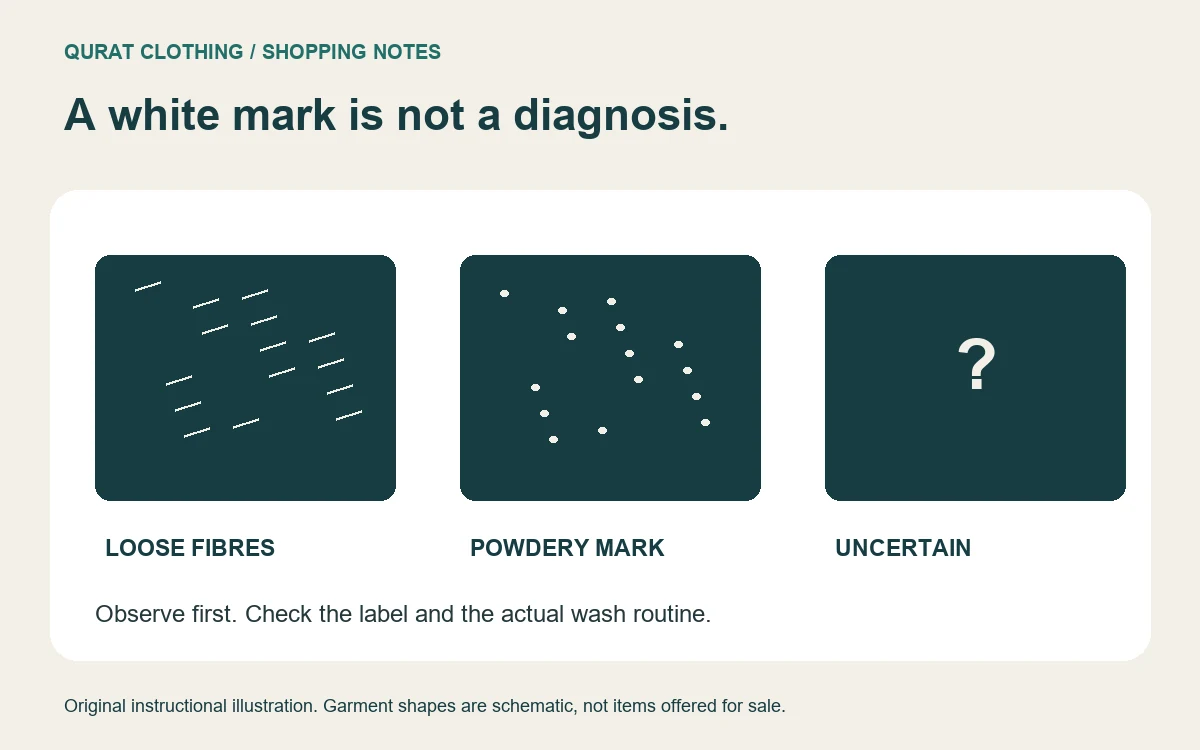
White marks after washing are not always the same problem. They may involve loose lint, detergent residue or another interaction between clothing, soils, products and the wash routine. Inspect the dry garment and check its care label before adding more detergent or trying a stain-removal mixture.
A dark sweatshirt can make a pale mark very noticeable, but the colour contrast does not tell you what caused it. Treat the first inspection as a way to narrow questions, not as a home laboratory test.
Look at the form of the mark
Lay the garment on a clean surface in steady light. Are there loose fibres, powder-like clumps, a film in folds or a change in the fabric's own colour? Look at more than one area. Photograph the mark before brushing or wetting it, especially if you may need advice about the item.
Do not rub hard to see whether the mark will disappear. Abrasion can change the surface, and a wet patch can temporarily hide a mark without solving it. A piece that appears colour-damaged needs a different assessment from one carrying removable material on top.
Why one answer does not fit every wash
Whirlpool's product guidance on white residue lists several possible contributors, including lint, excess detergent, detergent build-up, water quality and interactions with body soils. Its advice also varies with washer and fabric requirements.
Use that as a reason to check the actual routine rather than assuming every pale mark needs the same treatment. Instructions for a particular washer model do not become universal instructions for every machine or garment. The clothing label, detergent directions and your machine manual all need to be compatible.
Write down what went into the load
Record the garments, the washing product and the amount used as accurately as you can. Note whether a towel or another lint-producing item was included, whether pockets were checked, and whether the load was unusually large. Avoid turning a suspicion into a fact: “washed with a pale towel” is an observation; “the towel caused every mark” is a conclusion you may not be able to establish.
If more than one person handles laundry, ask what was actually used rather than assuming the usual setting. A different detergent concentration can make a familiar-looking capful an unreliable measure. Use the product's own dosing instructions and the machine's requirements rather than a fixed internet recipe.
Check the label before rewashing
A second wash is not automatically the right first step. Read the garment's permitted temperature, cycle and drying instructions. If you are considering an additional rinse or another wash, confirm that it is appropriate for both the item and the machine.
Do not increase heat merely because a powder may not have dissolved. The garment may have a lower care limit, and a pale mark may have another cause. Similarly, adding extra detergent to an unknown residue problem can introduce more product without answering the original question.
Avoid combining household chemicals
An unidentified mark does not justify mixing bleach, acidic products, solvents or other cleaners. Apart from compatibility concerns, an improvised treatment can change the fabric or decoration and make it harder to understand the original issue. Use only a suitable product in the way its label allows, within the garment's care instructions.
If the material, decoration or mark is unfamiliar, ask an appropriate garment-care professional. Explain the treatments already attempted. “Nothing has been applied yet” is useful information; so is an accurate account of any product used. Do not leave out a step because it seems minor.
Inspect the machine through its own maintenance guidance
If marks recur across different suitable loads, consult the washer manual for the recommended checks and maintenance routine. Detergent drawers, filters and other components vary by model. Do not dismantle a machine or reach into it based on a generic clothing article.
Keep the observation separate from a diagnosis. Repeated marks suggest that the wider routine deserves attention, but they do not prove that the machine is faulty. A repair professional will need details about the model and symptoms if a service assessment becomes appropriate.
Handle a new purchase differently
If a mark was present when the parcel arrived, record it before wearing, washing or treating the item and contact the retailer. Qurat Clothing's current return policy explains how to report an incorrect or defective product. Do not assume that a pre-existing issue must be washed away before it can be discussed.
When buying new casualwear, read the fabric, condition and care information alongside the price. Browse women's tops or other Qurat Clothing collections for the item you need, then check the individual listing. No garment category guarantees a particular washing method.
Make the next load a considered choice
Use the finding to improve sorting and dosing rather than adding more products by habit. Our family laundry sorting guide covers the broader planning step. Keep your care notes with any item that needs different handling.
For example, keep notes on a dark top with loose pale fibres separately from a dark top with a film in its folds. Even if both were in the same load, one description should not replace the other. Record any permitted treatment and compare the dry result in similar light. If a mark remains, explain exactly what was attempted when seeking advice. This avoids repeated treatments based on a changing memory of the original appearance.
The aim is a clear sequence: identify what you can see, record the routine and choose a compatible next step. That is more useful than labelling every white mark “detergent” and applying the same remedy to all clothes.
White marks appear on one part of a wash load
Dark trousers show pale streaks after washing. A separate top has visible fibres on the surface. The wearer should not automatically describe both as detergent residue.
| Record | What to compare or ask |
|---|---|
| Distribution | Record which garments and areas are affected. |
| Surface | Describe loose-looking fibres separately from flat marks. |
| Load history | Keep product use, care settings and earlier treatments. |
What this example helps you decide
Match the observation to the next enquiry and label-compatible care decision. A photograph can document a pattern without proving that lint, residue or colour change caused it.
For an item enquiry, include the QC code, selected size and the specific detail you need clarified. Keep an observation separate from an assumption, and retain any relevant photographs with your order record.
Comments
Be the first to comment.