
Oil, Food, Mud or Adhesive: Plan Clothing Stain Care by the Actual Mark
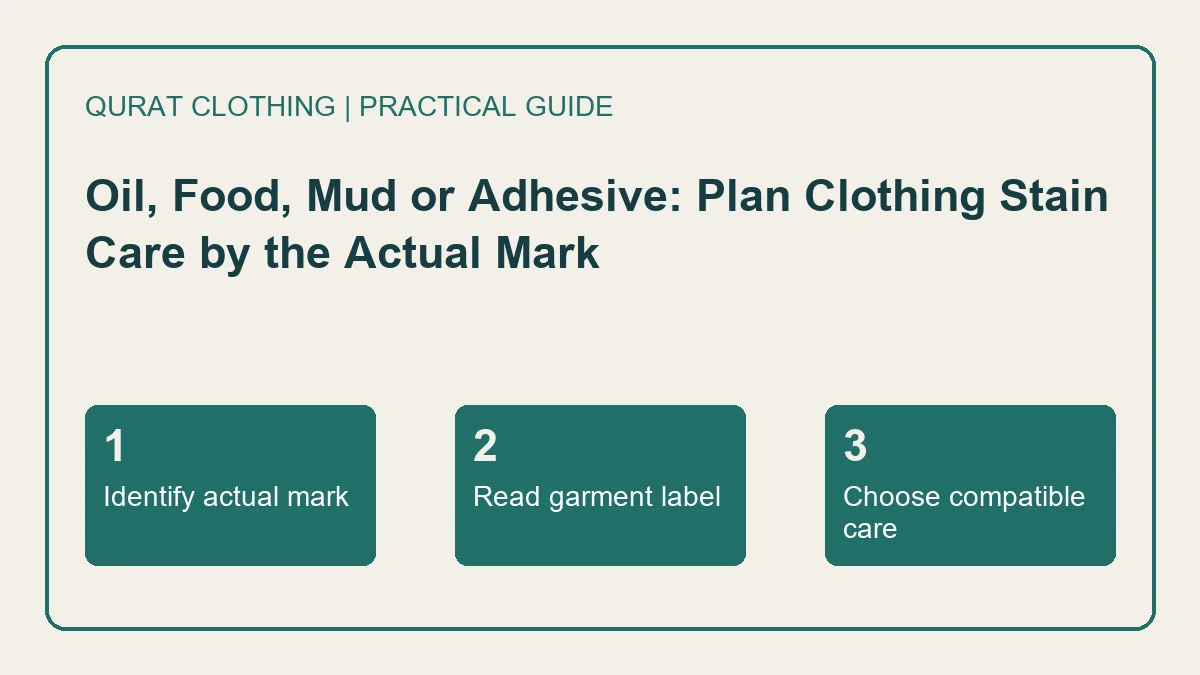
Plan stain care around the actual mark and the garment's label. Oil, food, dried mud and adhesive residue can need different handling, and an unknown mark should stay unknown until there is useful evidence. There is no single household treatment that is suitable for every stain, fibre and decoration.
Start with the label and a short history
Record what contacted the garment, when it happened and whether any treatment has already been applied. Read the care label before choosing water, heat or a cleaning product. For a dry-clean-only item, explain the mark to a professional cleaner instead of assuming a small home treatment is exempt from the instruction.
If the mark was present on a newly delivered garment, photograph it and contact Qurat Clothing before cleaning. Our delivery inspection guide covers the evidence to keep. Check the return policy rather than assuming a cleaned or altered item remains eligible.
Oil or greasy food
Remove excess material gently without spreading it across a wider area. Blot rather than rubbing it deeper. For a washable garment, choose only a pretreatment compatible with its label and follow the product directions. Do not apply a strong solvent simply because the stain seems oily.
Whirlpool's oil-stain guidance stresses checking the label and avoiding drying before the stain is dealt with. If a treatment uses dishwashing liquid, its residue needs appropriate rinsing before machine washing; it is not a substitute for laundry detergent in the appliance.
Food marks with more than one component
A sauce may contain oil, colour and other ingredients. Describe the actual food if known, and remove loose solids without scraping the fabric aggressively. Avoid treating every food mark as the same chemical problem. Use a compatible product's instructions instead of combining several recipes.
After the permitted cleaning step, inspect before applying dryer heat or an iron. A remaining mark is a reason to reassess, not automatically to increase the temperature. If the treatment risks the print or finish, seek advice before continuing.
Mud and loose dirt
Distinguish loose surface dirt from a remaining stain. Avoid grinding grit into the fabric. Follow the label and a suitable treatment's directions for the material involved. A delicate surface or attached decoration may need different handling from sturdy washable trousers.
Once loose dirt is dealt with, reassess the actual mark. Do not assume a brown patch is still mud if the colour or fabric surface has changed. Our colour-transfer guide explains why an added deposit and missing colour are different observations.
Adhesive or sticky residue
Identify the source where possible: a label, tape, gum and glue are not interchangeable. Do not pull strongly at a stuck patch or apply heat to an unknown adhesive. A product marketed as an adhesive remover must still be compatible with the textile, colour and decoration.
Whirlpool's general stain guidance advises testing compatible treatments and keeping dry-cleaning solvents out of washing machines. Avoid mixing products, and tell a professional what you have already used if you seek help.
Decide when to stop
Stop if the colour lifts, the surface changes or instructions rule out the next treatment. No article can guarantee removal without examining the garment. For future purchases in boys', girls', men's or women's clothing, choose care requirements you can realistically maintain. A sensible routine is more useful than a promise of stain-proof clothing.
A food mark contains more than one material
A sauce spill leaves both an oily-looking area and colour on a washable-looking top. The wearer has not yet checked the care label or identified which products have already touched the mark.
| Record | What to compare or ask |
|---|---|
| Source | Describe the known food or keep the source uncertain. |
| Garment | Read the actual care instructions and decoration details. |
| Treatment history | Record anything already applied. |
What this example helps you decide
Choose the next step from garment-compatible, authoritative instructions for the actual mark. Do not combine several household recipes or assume that one visible colour identifies every component of a stain.
For an item enquiry, include the QC code, selected size and the specific detail you need clarified. Keep an observation separate from an assumption, and retain any relevant photographs with your order record.
Comments
Be the first to comment.