
Why Is a Jeans Seam Twisting? A Practical Inspection Guide
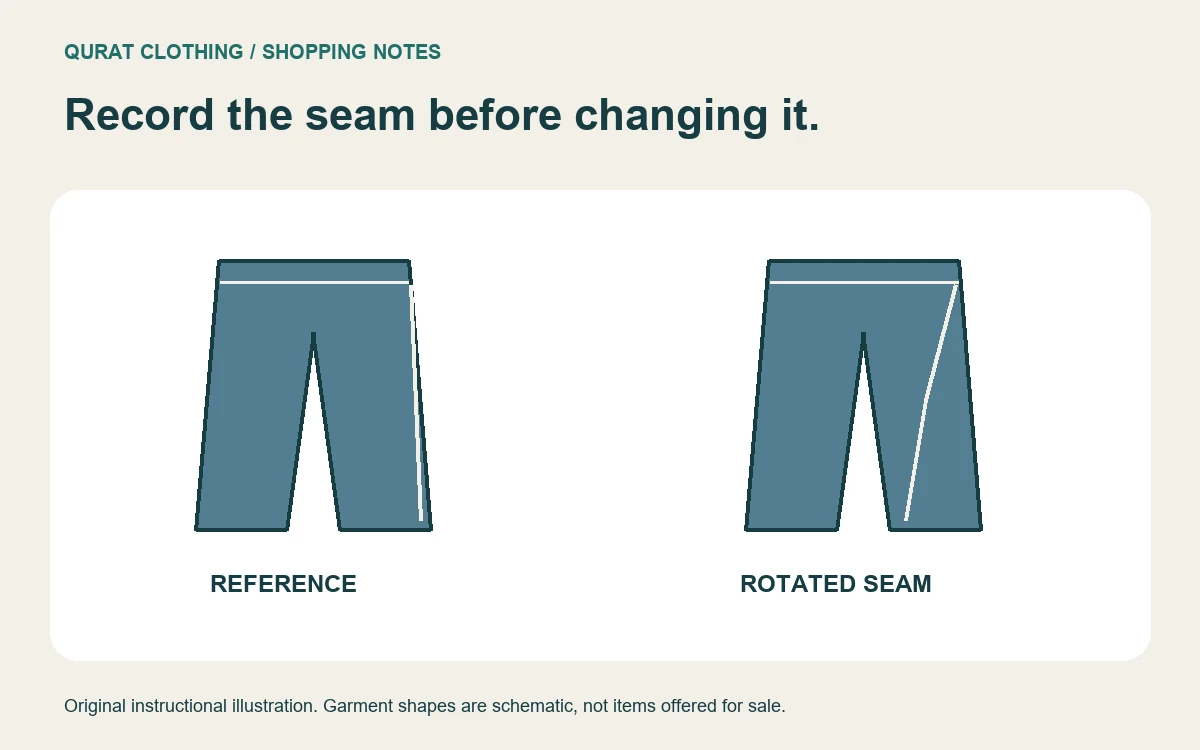
A jeans seam that rotates around the leg can be described as leg twist or skew. It may relate to fabric construction and finishing, and it cannot be diagnosed reliably from one photograph. Compare the garment's condition, timing and fit before trying to pull or iron the seam back into position.
The useful first question is not “Which trick will fix this?” It is “What has changed, and when did it change?” A clear record helps distinguish an existing design or construction feature from a newly noticed problem.
Establish which seam you mean
Jeans have inner and outer leg seams, and their apparent position can change with the way the garment is laid out or worn. Place the dry pair on a flat surface without pulling it into an ideal shape. Photograph the front, back and the affected leg from a consistent position.
Compare both legs. Note whether one seam turns more than the other, whether the waistband is level and whether the hems sit differently. A quick picture taken while holding the jeans by one corner may exaggerate or hide the effect, so use the same arrangement for any later comparison.
Understand the manufacturing term cautiously
CottonWorks' technical discussion of skewing explains that denim can be pre-skewed during fabric finishing and that the amount of this treatment matters. Its denim basics guide also identifies yarn twist as one of several factors affecting fabric behaviour and appearance.
These manufacturing explanations show why a twisting seam should not automatically be blamed on a customer's washing routine. They do not prove the cause in an individual pair. Establishing that would require appropriate examination and, in some cases, textile testing.
Record whether it was present before washing
If you noticed the seam on arrival, compare it with the actual listing photographs and contact the retailer before washing or altering the item. A new purchase should not need a home experiment simply to establish what was supplied.
If the effect became noticeable later, write down the sequence: first try-on, first wear, washing and drying. Be specific about any known settings, but leave uncertain details uncertain. An old pair with no arrival photographs may not allow you to establish exactly when the change began. That uncertainty should remain part of the report.
Separate fit from seam alignment
A pair that feels tight through the thigh or seat may sit differently on the body from one with more room. Check whether the twisting appearance is visible when the garment is laid flat, only when worn, or both. Do not treat a flat photograph as a complete fit assessment.
Try the garment only in a normal, comfortable way. You do not need to force a deep bend or stretch the fabric hard to document the issue. If the fit is uncomfortable, record that separately from the visual seam change. Two observations may be related, but they should not be collapsed into one assumed diagnosis.
Avoid forcing a correction
Pulling a wet leg into position, repeatedly applying heat or altering the seam can change the garment further. Unless the manufacturer gives a suitable instruction for that specific piece, those steps are not a dependable way to reverse skew.
For a new item, ask the seller for an assessment first. For a well-used pair, a competent alteration professional may be able to discuss options, but ask about limits before agreeing to work. A visually straighter seam after pressing does not prove that the underlying fabric behaviour has changed permanently.
Make your message to the retailer useful
Include the product reference, selected size, date of receipt and when the effect was first noticed. Add the photographs taken with the garment arranged consistently. State whether it has been worn, washed, dried or altered, and include the care label if readable.
For example: “The outer seam on the left leg turns toward the front when the pair is laid flat; this was noticed before washing. The right leg appears different in the attached comparison.” This reports the observation without claiming a manufacturing defect that has not yet been assessed.
Qurat Clothing's return policy explains how to raise an issue and the condition requirements for eligible items. Do not assume that alteration is required before contacting support.
Use the experience to make a better comparison next time
Before ordering jeans online, compare waist, rise, thigh room and leg shape with a useful reference pair. Inspect front and back product photographs and read condition notes. Our trouser measurement guide provides the broader measuring method.
Browse the relevant men's bottoms, women's bottoms or children's pants categories at Qurat Clothing. Confirm that the individual listing is denim and that the selected size is available. A category page can include several types of trousers.
A useful before-and-after comparison
Suppose a pair looks different after its first permitted wash. Use the same flat surface and camera position for the next photograph as for the arrival photograph. Keep the waistband arranged consistently, and do not pull one leg straight while leaving the other relaxed. Note the washing and drying instructions followed. You are building a record, not proving a cause. If no arrival photograph exists, say so; a careful current photograph remains useful even when a complete history is unavailable.
Observation first, remedy second
A twisting jeans seam is a reason to inspect and document the pair, not to assume misuse or a guaranteed home fix. Keep the evidence clear, follow the garment's care instructions and seek an assessment before changing the item.
A knitted top's side seam is a different comparison
If a T-shirt side seam appears to turn towards the front, record it separately from denim leg twisting. A knitted top and a woven denim trouser have different constructions, so do not transfer one explanation automatically to the other.
Lay the top relaxed and photograph front, back and both sides without pulling it square. Compare with a pre-wash image if available and note the actual cleaning method. Without that baseline, describe when you noticed the change rather than claiming a measured amount of rotation.
Our garment measurement article helps make before-and-after notes consistent. For a recent purchase, contact Qurat Clothing before alteration and read the return policy. When comparing boys' tops or girls' tops, use the actual item photos and dimensions rather than treating a seam position alone as proof of cause or authenticity.
A jeans leg seam sits differently after use
A wearer notices that a side seam appears closer to the front of the leg. The comparison needs a relaxed flat view and, if available, an earlier view taken in a similar arrangement.
| Record | What to compare or ask |
|---|---|
| Flat arrangement | Photograph both legs without forcing the seams into place. |
| Worn observation | Describe where the seam sits in ordinary use. |
| History | Record washing, drying and any attempted reshaping. |
What this example helps you decide
Keep a twisting-seam observation separate from overall size or fit preference. Do not force an apparent correction with heat or stretching before the actual garment and instructions have been assessed.
For an item enquiry, include the QC code, selected size and the specific detail you need clarified. Keep an observation separate from an assumption, and retain any relevant photographs with your order record.
Comments
Be the first to comment.